A submission to the Standing Committee on Finance and Economic Affairs regarding the 2014-15 Ontario Budget
Introduction: The Age of Anxiety
Planning for the 2014 Ontario budget is taking place in an uncertain environment. First of all, no one can say whether the process will produce an actual budget; under the current circumstances, the budget process is just as likely to produce an election platform for the governing party as a fiscal plan for the province.
But the uncertainty surrounding the upcoming budget pales in significance when compared to the greater uncertainty Ontarians are experiencing as they go about their daily lives.
According an October 2013 report by the EKOS polling firm, Canadians – and Ontarians – are deeply concerned about the future. In terms of quality of life, 48 per cent of Canadians surveyed told EKOS that they expect the next generation will be worse off, 25 years from now, than people are now. In Ontario, this number was 59 per cent, or more than five times the number (11 per cent) who thought the next generation would be better off. 1 A January 2014 report by the Pollara polling firm indicated that 37 per cent of Ontarians think it is very or somewhat likely that a member of their immediate family will lose his or her job in the next twelve months; this number appears to correspond to the 38.5 per cent who told EKOS that “I feel I have lost all control over my economic future” last fall. Pollara’s research found that 57 per cent of Ontarians believe the economy is in recession (even higher than the 52 per cent found in the EKOS survey), even though real growth in the economy resumed in mid-2009.2
Economic concerns are linked to people’s ability to feed and house their families, pay heating and electricity bills, and save for post-secondary education or retirement. It is no surprise that they form a major part of Ontarians’ concerns about the future. But when asked about their deepest concerns, economic issues did not eclipse issues related to politics and public morality. In the EKOS survey, respondents chose “Acute decline of our democratic and public institutions” as their paramount concern for the future, followed by the cost of caring for an aging population, “A severely environmentally degraded future” and “The ethical collapse of society and soaring corruption.” (“A dark/diminished economy for the next generation” ranked fifth.)
The idea that what might be thought of as “process” issues around democracy and ethics could eclipse bread-and-butter economic concerns in the public mind may seem surprising, yet it makes perfect sense: Canadians see the honesty of our politicians and the integrity of our public institutions as fundamentally central to solving our economic (and environmental) problems. Yet to a large degree citizens hold out little hope that politicians will work towards a better future for all, EKOS President Frank Graves believes:
Voters seem to think that all choices lead to the same outcome: governments run by parties which place their own interests and the interests of the powerful ahead of those of the public. In fact, if we were to isolate the one factor driving declining trust in government it would be just that: the corrosive belief that the public interest has been subordinated to other interests in modern politics.3
Politicians have certainly acquitted themselves poorly of late. In the past year, Ontarians have seen the Senate expense scandal consuming political debate at the federal level, revelations of gross waste of public dollars for political advantage at the provincial level, and exceptional displays of narcissism, mendacity and criminal conduct by prominent municipal politicians. Yet public mistrust of our leaders goes beyond politicians. Increasingly, citizens around the world are seeing the links between political and business leaders. So while the October 2013 EKOS survey found “Economic decline in the United States” as the number one driver of recent economic stagnation in Canada (a reasonable enough choice), respondents ranked “Corporate greed and corruption”, “Our leaders failing to create a blueprint for success,” and “An excessive share of profits going to the wealthy” close behind.
If polls are to be believed, the majority of citizens simply don’t believe their leaders care about their problems. And they don’t yet know what to do about it.
When weather-related insurance claims in Canada are at record levels 4, Ontarians know that something must be done to protect the economy and save human lives from increasingly frequent flooding, ice storms and heat waves. When they are waiting longer to see a doctor than citizens in other developed democracies, Ontarians know that the public services deficit in this province is reaching unacceptable levels.5 When more and more jobs offer only part-time, temporary work with poor or non-existent benefits and wage rates that keep even full-time workers locked in poverty, Ontarians know that our economy is not being managed in their interests.
The anxiety Ontarians feel today is the result of not just years, but decades, of political and economic change designed to transfer wealth and power from working people to a small ruling elite.
How We Got Here: Turning Points
The period immediately following World War Two was a time of rising prosperity in Ontario. Anchored by a booming auto industry that had produced over 800,000 vehicles for the government-funded war effort, 6 Ontario industry quickly converted to producing consumer goods for a North American population that had “gone without” for much of the 15 years of the Great Depression and the war. The legal foundation for a successful trade union movement was laid out in a landmark arbitration ruling by Supreme Court Justice Ivan Rand in 1946, and rising union density was accompanied by rising wages across the economy. Successive Conservative provincial governments of the postwar era built roads, schools, and hospitals with steady determination and did not hesitate to borrow the money or raise the taxes needed to do so. Explaining the need for a new three per cent retail sales tax – at a time when the province’s corporate income tax rate was 52 per cent and the economy was in recession – Ontario Treasurer James Allan told the legislature in 1961 that
…a further postponement of the imposition of a sales tax could only be realized at the expense of imperiling our financial position and therefore our capacity to assist our municipalities and our ability to promote the orderly extension of services, without which communities cannot grow nor industry expand. Lack of action at this time would only undermine our financial position, jeopardize our credit and slow down the rate of our economic expansion both now and in the future, thus detracting from rather than contributing to high and stable levels of employment and income.
We must face up to realities. The program we have announced is designed to promote expansion and increase employment. If we forego the revenue from our sales tax, we must cut back on our services, our capital works and our assistance to municipalities and school boards. I think you will agree that at this time – when the pace of our economy has slackened – we need courage, vision, enterprise and bold action. The Budget that I am introducing today responds to this need.7
A few years after introducing the sales tax, the 1960-61 recession was in the rear view mirror and the same Treasurer could report in 1964 that “Reviewing the economic conditions of the past year is a pleasure.” 8 The Auto Pact, signed in 1965, encouraged economies of scale and guaranteed the Canadian auto industry a proportional share of the North American market. The Auto Pact was emblematic of the successful “managed trade” approach taken by Canadian governments at the time. Government policy sought “human betterment” and prosperity through active government support of both people and industries:
For our own part, we have continually sought to provide the environment in which growth can flourish. Indeed, we have initiated many far-sighted policies designed to exert a positive influence upon the economy. In the field of social services, we have diligently striven to promote the development of human resources and thereby assist our people and industry in achieving their maximum potential. The creation of new physical assets in the form of universities, schools, hospitals, highways, parks and other public works, and the development and conservation of our natural resources have also been important economic stimulants. In these and other ways, we have contributed in no small measure to our economic progress and rising living standards.9
Managed trade, strong trade unions, and muscular government that was unafraid to invest in the province and its people – and unafraid to pay to do so – laid the foundation for an economy that made Ontario the unchallenged economic leader in confederation. This happy condition would persist until well into the 1980s.
The Canada-U.S. Free Trade Agreement (FTA) which came into force on January 1, 1989 began a restructuring process that has fundamentally changed the economy of the country overall and Ontario in particular. Six years earlier, not-yet-Prime-Minister Brian Mulroney had commented that “All that would happen with free trade would be the boys cranking up their plants throughout the United States in bad times and shutting their entire branch plants in Canada.” 10 And while Mulroney famously changed his mind about free trade, his prediction came true nonetheless, and many Canadian industries re-located outside the country. 11
Opponents of the FTA had warned that reducing restrictions on capital flows across the Canada-U.S. border would put downward pressure on Canadian tax rates and reduce the funds available for public services like Medicare. This premonition came true with the election of the Mike Harris government in 1995.
The centerpiece of the Harris program was tax cuts. Harris vowed to cut Personal Income Tax (PIT) rates by 30 per cent,12 and he did so. In 1999, Harris promised to reduce the PIT by a further 20 per cent, and by the time of the 2000 budget, then Finance Minister Ernie Eves could boast that the government had made 99 tax cuts since being elected, including a reduction in the Employer Health Tax and various targeted tax deductions for business.13
Tax cuts, of course, demand cuts to program spending; annual program spending in the Harris-Eves era fell from 17.7 per cent of GDP to 13.6 per cent (equivalent to a $25 billion drop in today’s economy). Hard-hit were public service employees, who saw their numbers reduced by more than 20,000, and social assistance recipients, who saw their incomes reduced by 22 per cent – a number which grew even larger, in real terms, as a result of inflation. It was in the Harris years that homelessness made itself visible on our city streets.
Program spending recovered to some degree with the election in 2003 of Dalton McGuinty and the Ontario Liberal Party, but the current government’s stated goal is to return program spending to 14.5 per cent of GDP by 2017-18. 14 This is to be accomplished by sustained program cuts. The 2012 Ontario budget, the government’s long-term blue-print, called for six years of cuts in real program spending averaging 2.3 per cent per year, or close to 15 per cent, after compounding, over the six-year period.15
What the Wynne government has yet to acknowledge is the deep hole in the budget caused by the tax cuts of the Harris years. While the introduction in 2004 of the Ontario Health Premium is currently recovering some $3 billion a year to public coffers, Liberal cuts to the Capital Tax, Corporate Income Tax rates, and personal income tax rates are costing the government an equal amount. The net result is that, more than 18 years after Mike Harris was first elected, the province has approximately $17 billion a year less to spend (see chart). 16 In other words, the provincial budget deficit, most recently estimated at $11.7 billion, would not exist if tax rates had remained at their 1995 levels.
This is the fiscal context for the 2014-15 budget.

Assessing Our Needs, Proposing Solutions
The budgeting method used by James Allan, Ontario Treasurer from 1958 to 1966, took a markedly different approach from the one employed by Ministers of Finance in recent years. To begin with, Allan’s calculations around his budgets began with an assessment of needs, not costs. Principal needs were those of people, which could be met by public services, or the economy, which could be met by public infrastructure (including the development of human infrastructure through education, health care, and social services). Once needs were established, the Treasurer then looked for financial resources to meet those needs.
In recent years, the province has often seemed to care more for the needs of its corporate executives and its creditors than its citizens. In the 2009 Ontario budget, for example, we saw the announcement of cuts to the corporate income tax rate and the continued phase-out of the Capital Tax, even though both of those measures transferred money directly from people (and the public services they need) to businesses and also increased the provincial deficit. The introduction of the Harmonized Sales Tax (HST) in July 2010 also transferred money from citizens to businesses, yet the income tax cuts designed to offset those extra costs have been paid for out of reductions in public service. Not unlike the Harris-era income tax cuts that went disproportionately to the highest-income earners, the shuffling of dollars to the benefit of well-heeled business interests in the McGuinty era did little to lessen the anxiety many citizens were experiencing. And while the fixation on the provincial deficit is no doubt allowing the province’s creditors to sleep comfortably at night, most citizens may be forgiven if they are more concerned about their own debts, which are now at record levels, 17 or the vital public services they cannot get access to because of relentless budget cuts.
Jobs
The imbalance Ontarians see in the handling of public finances is paralleled by an imbalance in the labour market. Median incomes for working people in Ontario have been stagnant for a generation, with the only change being a decrease in incomes at the lower end of the spectrum accompanied by an increase at the higher end.18 Households have compensated for this by taking on more debt (as noted above) and working more hours, yet their venture into today’s fragmented workforce often finds them in part-time or temporary work, or low-paid self-employment. In the Greater Toronto and Hamilton Area, “Barely half of those working today are in permanent, full-time positions that provide benefits and a degree of employment security.”19
On the wage front, nine per cent of the population is now working for the minimum wage of $10.25 an hour (double the rate of a decade ago), and 28 per cent of the workforce earns $14.25 an hour or less. 20 Meanwhile, at the other end of the spectrum, Canada 100 highest-paid CEOs received average compensation of nearly $8 million each in 2012, a number equal to 171 the average wage of a full-time full-year worker.21 Income inequality has reached epidemic proportions in Canada – and in Ontario.
There can be little dispute that one of Ontario’s most pressing needs is, thus, more jobs, with better incomes and more stability, for more people.
To understand what needs to be done for Ontario’s economy, we need to look at what is, or isn’t, driving economic growth.
In the first years of this century, from 2000 to 2007, Ontario’s economy was driven by strong household spending, strong government spending, and some business investment. Exports played a major role in keeping Ontarians working, but the money earned through those exports was less than the money needed to pay for imports, so net trade did not add to GDP growth overall.
In the period from 2008 to 2012, household spending fell as people lost jobs and wages to the Great Recession; government spending stayed steady as the Ontario government, like governments around the world, moved to stabilize the economy with stimulus spending in the form of infrastructure investment; business investment was negative; and net trade did not improve.
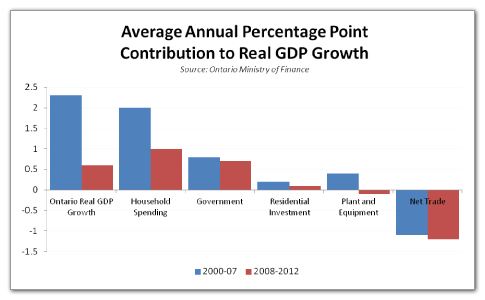
Looking ahead, Ontarians are now living in a time when government spending is negative and wages for workers in the provincial public sector have been driven below the rate of inflation as a result of the austerity policies the government first announced in 2010 and began to enact with increasing determination with the 2012 budget. Both measures are keeping the economy weak. To repair Ontario’s economy – and provincial finances – after the recession, three main things are needed: first, boosting domestic demand by putting more Ontarians back to work and restoring spending power for working people; second, further boosting demand and meeting people’s needs by increasing government spending on vital public services and infrastructure; and third, improving the trade picture by selling more exports, buying fewer imports, or both.
It is not as if the province is broke. Despite the recession, Ontario’s GDP is higher than it has ever been. More importantly, Ontario’s GDP per capita, which peaked in 2007 before the Great Recession, is now less than one per cent below that all-time record, and based on ordinary estimates of population and economic growth, will surpass it sometime in the summer of 2014. 22

In other words, there is more money in this province than ever before. The problem, however, is that it is more unfairly distributed than ever before. As Statistics Canada pointed out in December 2013, the richest one per cent of Ontarians now collect 12 per cent of the income in this province, a rate second only to Alberta.23 Canadian corporations, meanwhile, are hoarding close to $600 billion in cash that they are not investing. The reason for this is simple: their customers are broke – up to their eyeballs in debt. Until we shake loose some of the “dead money” corporations are holding, 24 consumer spending is likely to remain weak.
Ontario has now reached the point in the Monopoly game where one player (the corporate sector) holds most of the cash while the other players are scraping by, rolling the dice and hoping to survive another turn.
A new game is needed in Ontario, and one way to start it is with tax fairness. Both Prime Minister Stephen Harper and former Ontario Premier Dalton McGuinty tried to stimulate business investment with corporate tax cuts, but that failed: it gave corporations more money but did nothing to make new investment happen. What will cause new investment is increasing aggregate demand via more spending in the economy. The simplest thing to do, under the circumstances, is for government to raise money through tax fairness measures and then plow it back into the economy in the form of public services and infrastructure.
Public spending is a key pillar of our economy. It supports the physical and human infrastructure the economy needs, it provides much-needed jobs, and it can sustain the economy when the private sector stalls.
-
OPSEU supports increased funding for public services and public infrastructure. Specific tax measures to support public spending are discussed below.
But government spending is not the only means to build consumer spending in Ontario.
Low-income workers are notorious for spending all of their income, and spending it where they live. Unlike wealthier individuals, who may take trips abroad, invest in foreign stocks, pay down debt, or simply add to their savings, low-income workers spend all their money on basic necessities. Hence, an increase in the minimum wage to a rate above the poverty line – in the area of $14 an hour – would have the double effect of not only raising living standards for low-income workers, but of increasing aggregate demand as well, thereby creating employment.
-
OPSEU supports the call for an increase in the legislated minimum wage to $14 an hour.
-
Consumer spending power also grows when strong unions are able to negotiate fairer wages for the workers they represent. Ontario needs legislation to make union organizing and collective bargaining easier, not harder.
Some critics suggest that labour laws designed to help unionized workers negotiate fair wages for themselves are driving jobs out of Ontario. This is incorrect. When Heinz recently announced the closure of its plant in Leamington, Ontario, at a cost of 740 jobs, it also announced the closure of a plant in Florence, South Carolina, which already had rock-bottom labour costs. 25 Kellogg’s recently announced the closure of its cereal plant in London, Ontario but has also locked out its workers in Memphis, Tennessee for refusing to go along with the company’s plan “to replace steady, middle-class, full-time jobs with casual, part-time employees who would make significantly lower wages [$6 less per hour] and substandard benefits.”26
For workers on both sides of the border, the issue is not labour law, but the kind of corporate greed that offers $6.6 million a year for Kellogg’s CEO John Bryant while destroying the middle-class working class.
Manufacturing workers in Canada face another challenge: the consolidation of production south of the border. As noted above, this consolidation was predicted by opponents of the Canada-U.S. Free Trade Agreement in the 1980s. Even so, Canadian manufacturing did recover from the shock of the FTA and the subsequent inclusion of Mexico in a larger North American Free Trade Agreement (NAFTA), and by 2002 manufacturing employment had reached a new peak. The cause had nothing to do with the percentage of unionized workers in manufacturing, which changed only a little during that era, and everything to do with the value of the Canadian dollar. In 2002 the dollar fell below 62 cents U.S. Within five years, though, one Canadian dollar was once again buying one U.S. dollar, and as the dollar rose, manufacturing employment fell.
According to the Organisation for Economic Cooperation and Development, whose members are the top industrialized countries, the actual value of the Canadian dollar should be in the range of 81 cents U.S. 27 At this level, the lower price of Canadian manufactured goods and services would allow Canadian exporters to make new inroads into U.S. and other markets, but without driving down workers’ wages (and consumers’ spending power) as some have proposed. (In the current environment, where the Bank of Canada fears deflation more than inflation, prices are unlikely to rise to any significant degree until such time as the economy is working much closer to full capacity.)
Fortunately for Ontarians who care about manufacturing, which is a highly productive sector with significant economic spin-offs, the value of the Canadian dollar may be returning to its “natural” level, quietly aided by the Bank of Canada. The latest rate of 90 cents U.S. is a significant improvement over recent levels. We can expect to see corresponding improvements in Ontario’s net trade picture before long. These can only help the province do a better job of meeting the needs of its citizens.
Basic human necessities for all Ontarians
With respect to Ontario’s needs, those needs are most dire at the bottom of the economy, where those who cannot find work, or sufficient work, subsist alongside those who are unable to work. Those on social assistance live far below any measure of the poverty line. In its 2013 report, the Campaign 2000 anti-child-poverty group reported that:
Policy decisions driven by austerity in the 2012 Ontario budget made survival even more difficult for the over 383,000 children living in poverty with their families. A focus on deficit reduction in Budget 2012 derailed effective anti-poverty measures that reduced the overall child poverty rate in Ontario from 2008-10…. Income inequality has worsened for over a generation, robbing many low-income children and families of the hope and stability known by some members of older generations…. Living in poverty compromises children’s health, educational attainment and overall well-being. It also compromises Ontario’s economic potential, as limited opportunity means the skills and talents of low-income people are under-utilized.28
The indicators of poverty are plain enough to see. One 375,000 Ontarians use a food bank every month; one-third of them are under 18. 29 More than 158,000 households, a record number, are on waiting lists for affordable housing. 30
The marketplace cannot be relied upon to address the pressing needs of hundreds of thousands of Ontarians in poverty. OPSEU supports all measures to tackle poverty through government intervention in the form of new spending on housing and income supports to ensure that all Ontarians have access to nutritious food, safe and comfortable housing, and the necessities of life.
-
First among these is a significant increase in social assistance rates, far above current rates which suggest (for example) that a single adult in Ontario can live for a month on $626. Second among these is an ambitious public housing plan.
“Housing First” is an approach to homelessness developed in the United States and being used now in some Canadian cities. Its central principle is simple and based on need. Housing First gives homeless people an apartment to live in and access to a social worker to help them achieve social and financial stability. Housing First recognizes that homelessness has costs of its own – costs related to emergency room visits, interactions with police, or imprisonment, for example – and that the cheapest (and most humane) way to tackle homelessness is through permanent housing and support. The U.S. state of Utah has seen its homelessness rate fall by 78 per cent and is on track to eliminate homelessness altogether by 2015.31 This has been accomplished, the state says, at little cost: “Most of the progress Utah has made in ending chronic homelessness has happened with no new money. Instead, we’ve freed up existing resources by creating efficiencies in the system and re-investing in proven approaches.”32
-
OPSEU supports major public investment to end homelessness and eliminate waiting lists for affordable housing.
The public services deficit
Public services have an important role to play in reducing inequality, simply because citizens at all income levels receive approximately the same benefit from them.33 The province’s public services deficit has been growing steadily since the 2008-09 recession.
There are few, if any, public services funded by the province that are not facing intense cost pressures, and an exhaustive summary of how those pressures are affecting services would take many hundreds of pages. Suffice it is to say that 70 per cent of the caregiver jobs in the developmental services sector are part-time, insecure, and often low-paid; that college faculty are deeply concerned about cost-saving measures that are severing the face-to-face contact between teachers and learners; that there are too many vacant positions in the section of the Ministry of the Environment that deals with drinking water safety; that children with behavioural problems and people with disabilities face long waiting lists to get the help and support they need. University tuition fees in Ontario have been the highest in Canada for five years running. 34 A decade after the SARS Commission, which recommended keeping hospital occupancy rates at low enough levels to be able to absorb a sudden influx of patients with infectious diseases, Ontario’s hospitals are running at more than 98 per cent capacity, strongly suggesting that a repeat of the SARS crisis may be in our not-too-distant future.35
Across the public sector, OPSEU members and other public employees see growing needs being met with fewer and fewer resources every year.
Under the current circumstances, where austerity rules the day, it hardly makes sense to call for funding increases in one sector that is providing a vitally important service if any and all increases are paid for through cuts in other equally vitally areas. Prioritization is impor